Lincoln’s Speechwriter:
John Hay and the Friendship That Inspired American Eloquence
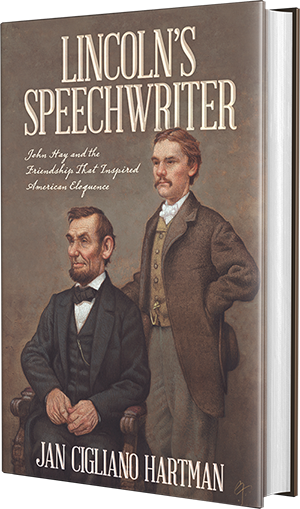
Voice, language, and friendship are at the heart of the story behind Lincoln’s speechwriter.
John Hay’s contributions to Abraham Lincoln’s political oratory—including his First Inaugural of March 1861, Springfield Farewell Speech of February 1861, the Gettysburg Address of November 1863, and Second Inaugural Address of March 1865, as well as many others—uplifted the president’s influence. An extraordinary transformation that appeared throughout his speeches, Hay helped launch Lincoln’s Republican campaign that culminated in Lincoln being elected the 16th president of the United States.
The rhyme and language of a writer’s voice is the living soul of narrative. The evolution of John Hay’s voice, established during his formative and college years at Brown University and echoed during his time with Abraham Lincoln, is documented in Lincoln’s Speechwriter through evidence of Hay’s distinct voice and Lincoln’s ability to engage audiences, fused into something remarkable, dissected through evidence of Hay’s and Lincoln’s original voices discovered/unearthered in the Library of Congress, Brown University Special Collections, and New York Public Library, among others.
Lincoln’s Speechwriter gives readers a closer look into the man behind the political voice that was Lincoln himself.
Praise for Lincoln’s Speechwriter
“Abraham Lincoln’s legendary addresses and writings are central to America’s once-clear understanding of itself as a paragon of democracy and defender of transcendent moral values. But did the famously plain-spoken Illinoisan write alone or benefit from the sophisticated word-smithing of a speechwriter in the shadows, as U.S. presidents both before and after him did? Jan Cigliano Hartman delves deeply into this provocative, controversial question in her new book, Lincoln’s Speechwriter: John Hay and the Friendship that Nurtured American Eloquence.”
— Blair Kamin, former Chicago Tribune architecture critic
“Abraham Lincoln’s legacy summons us to see democracy by the people as a collective project. Jan Hartman’s compelling exploration reveals that this was also true of the language Lincoln wielded to hallow that essential American ideal — deepening rather than diminishing our affection for his moral leadership, our appreciation of John Hay’s poetic gifts, and our devotion to the work their words call us to continue in our own divided day.”
— Stephen Krupin, senior speechwriter to President Barack Obama
“Jan Hartman’s writing will exit all readers… Her evidence cannot be ignored, since you have scoured John Hay’s archival record more than anyone else has done.”
— Richard M. Waugaman, Professor Emeritus of Psychiatry, Georgetown University; 2021 Author, Friendly Fire: Shakespeare’s Accidental Enemies, a Review of the Shakespeare Authorship Controversy
“In Lincoln’s Speechwriter, Jan Cigliano Hartman makes a strong case that John Hay had a greater role not only in writing Lincoln’s Cooper Union speech and those that followed until the assassination, but that the literary quality of the language in the speeches—such as the two inaugural addresses, the Emancipation Proclamation, and the Gettysburg Address—which is generally attributed to Lincoln himself, largely came from Hay. Hartman’s careful comparison of Hay’s own writings, beginning with those from his undergraduate years, with the language attributed to Lincoln, establishes Hay’s central role in several of the most important speeches in American history.”
— Robert Wilson, editor of The American Scholar for nearly two decades; author of biographies of Mathew Brady, P. T. Barnum, and Clarence King.
Order Now